
Constraints, as I talk about them in this blog, are high level constraints that will impact how you plan your project before you start construction. This is different than constraints (or roadblocks) you deal with during construction.
This is not meant to be a comprehensive deep dive, but a summary of the types of things you need to consider on a new project with some examples from my past projects and how we overcame them. It should pique your curiosity and get you thinking about your own projects and how to plan them.
Key constraints I cover are financial, schedule, and physical. These three constraints will exist on the majority of projects small or large.
A key skill associated with constraints is curiosity. Don’t make assumptions. Ask questions and dig for information.
Each section below walks through things I think about early in preconstruction and includes photos and examples.
FINANCIAL
Rarely will you find yourself on a project without a financial constraint. Every project in my 23 years experience had a financial constraint.
First, you should have some form of agreement in place to be paid for preconstruction services. I generate a letter for the client to sign that covers what will be provided and at what cost. Terms of this letter vary and I may cover this in a future post.
It is important to know if the client set a budget and how the project will be funded. The budget and type of funding are financial constraints. Ideally you get to help establish the budget and proceed with a target value design approach.
More often, in my experience, the budget is set and you have to provide an independent estimate to validate the budget and help guide the owner with potential changes or value engineering to meet their budget.
There are numerous ways the client may develop a budget and providing funding for the work.
Some examples of other types of financial constraints:
- Fundraising: Many organizations pay for construction through fundraising efforts. Estimates need to consider the gap in time between a conceptual estimate and when funding could be achieved. This can sometimes be more than a year and your estimate would need to account for escalation to assure enough money is raised.
- Complicated Financial Models: Development projects may have a multitude of funding sources such as City/State incentives, lenders, and investment directly by the company. This becomes complicated as these are not typically set values from each party. They can be reciprocal …so if the owner/partners invest X, the lender will provide Y, and the city will provide Z. As the value of the projects change and the dynamics of the financial market change XYZ will change with it. Changing financial markets such as the interest rate increases through 2022/2023 impacted several of our developer led projects.
- Public Funding: Public facilities often require approval of funds by a board or public vote. Your project may not move forward if the vote is negative.
EXAMPLE PROJECT | IU NATATORIUM RENOVATION
- Public project
- Funding is $20M and must not be exceeded
- Significant renovation and modernization needed throughout facility
- Facility must remain open during construction
- Owner concerned about how much work to include so bids will not exceed $20M
- Project also has schedule constraints to be complete for 2016 Olympic Dive Trials
- Project may not proceed if bids exceed funding and re-design would be required
- Re-design will significantly impact schedule
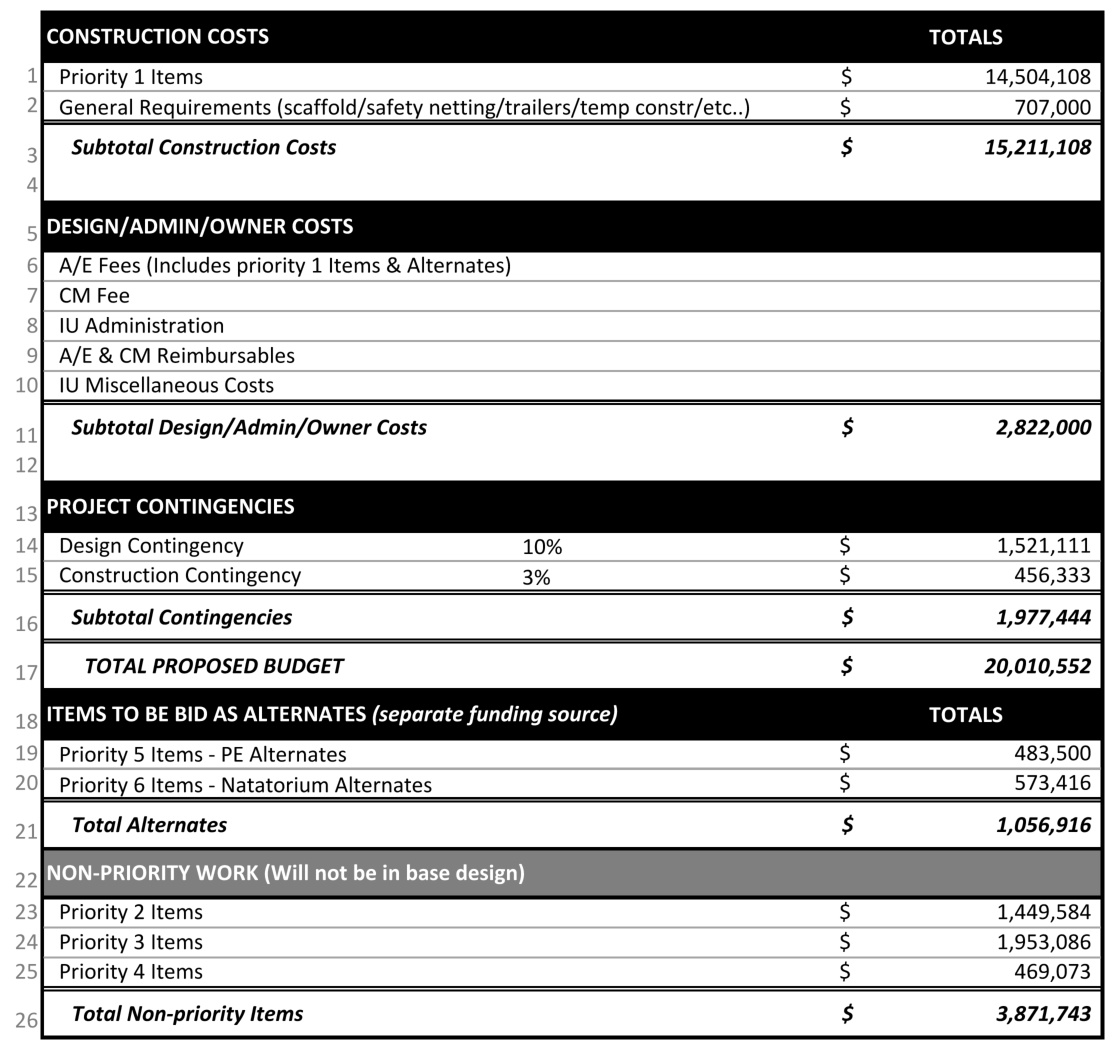
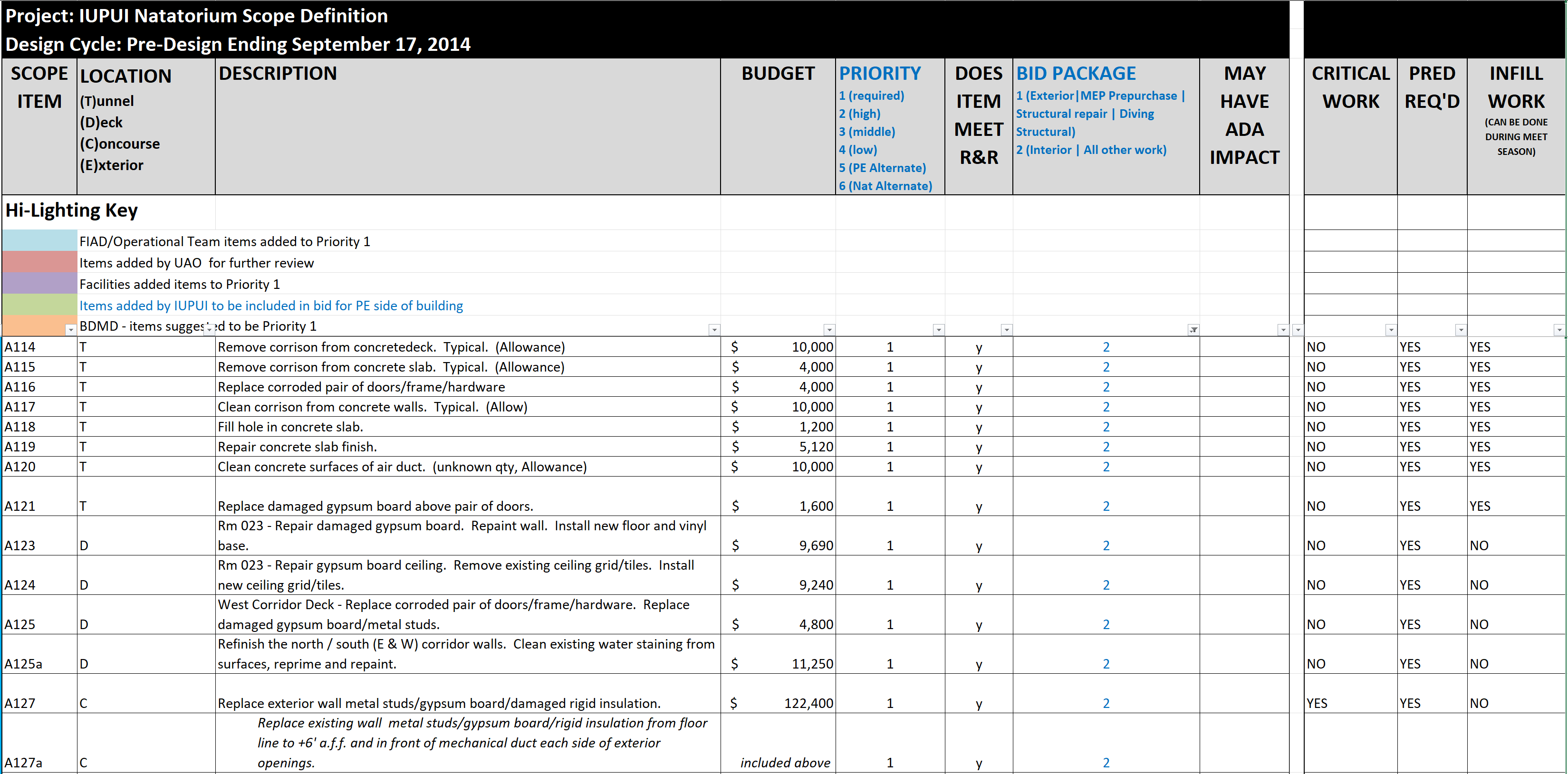
As a team, we came up with the solution to create a list of work items needed by system and by room. This turned into a comprehensive list of 285 line items. Each line item was backed up with a detailed estimate. This allowed us to rank each line item with a priority to see how close we were to the funding value. Below are some examples of the information we reviewed. Keep in mind this is a conceptual number and is why we show a large design contingency.
Line 17 shows our total proposed budget for priority 1 items was just over $20M giving IU confidence to proceed with design. This priority list could also be utilized later: If bids were below budget this list would be utilized to increase the scope of work. Overall, it was a very successful approach and the project was delivered on budget.
SCHEDULE
Every project has an end date. Sometimes you get to help set the date, but most of the time the client has a deadline in mind. The end date of the project is not the only constraint you will run into. There are many projects with schedule constraints throughout the project and it is critical to know this up front to help you plan your project.
- Potential schedule constraints
- If you work for a school system you typically have constraints around breaks and school year start and end dates (fall break, winter break, spring break, summer break). Most of my school projects required work outside the construction area to be done during these breaks and often requires overtime hours or even 24/7 operations to get critical work done while students are out of the building.
- Are you building student housing? If you miss your deadline for the start of the school year you have significantly impacted the client as they have now missed their critical window to lease units. These projects typically have liquidated damages as a penalty for missing dates and you need to account for this in your risk profile for the project.
- There are grants and similar funding that could apply to your project. These often have timelines associated with completion of the work for the Owner to receive the money.
- Lenders might have timeline requirements on their loans and when they need to close out the construction loan.
- The facility needs to be open for a specific event
- The client’s current lease expires at a specific date and they need to move before that date
- The CEO has announced a completion date to the board
- They are growing and will exceed their current capacity if the project is not done
- They need to open additional factory lines to meet demand and lose market share if they cannot.
- Timing to get permanent utilities to the site
I am sure you get the idea. These constraints are critical to understand so you can build your construction plan accordingly. You also need to be willing to speak up when something doesn’t make sense or a date is not feasible.
EXAMPLE PROJECT | IU NATATORIUM RENOVATION
- Public project
- Swim meets are a significant cash flow for the facility.
- As many meets as possible need to be maintained
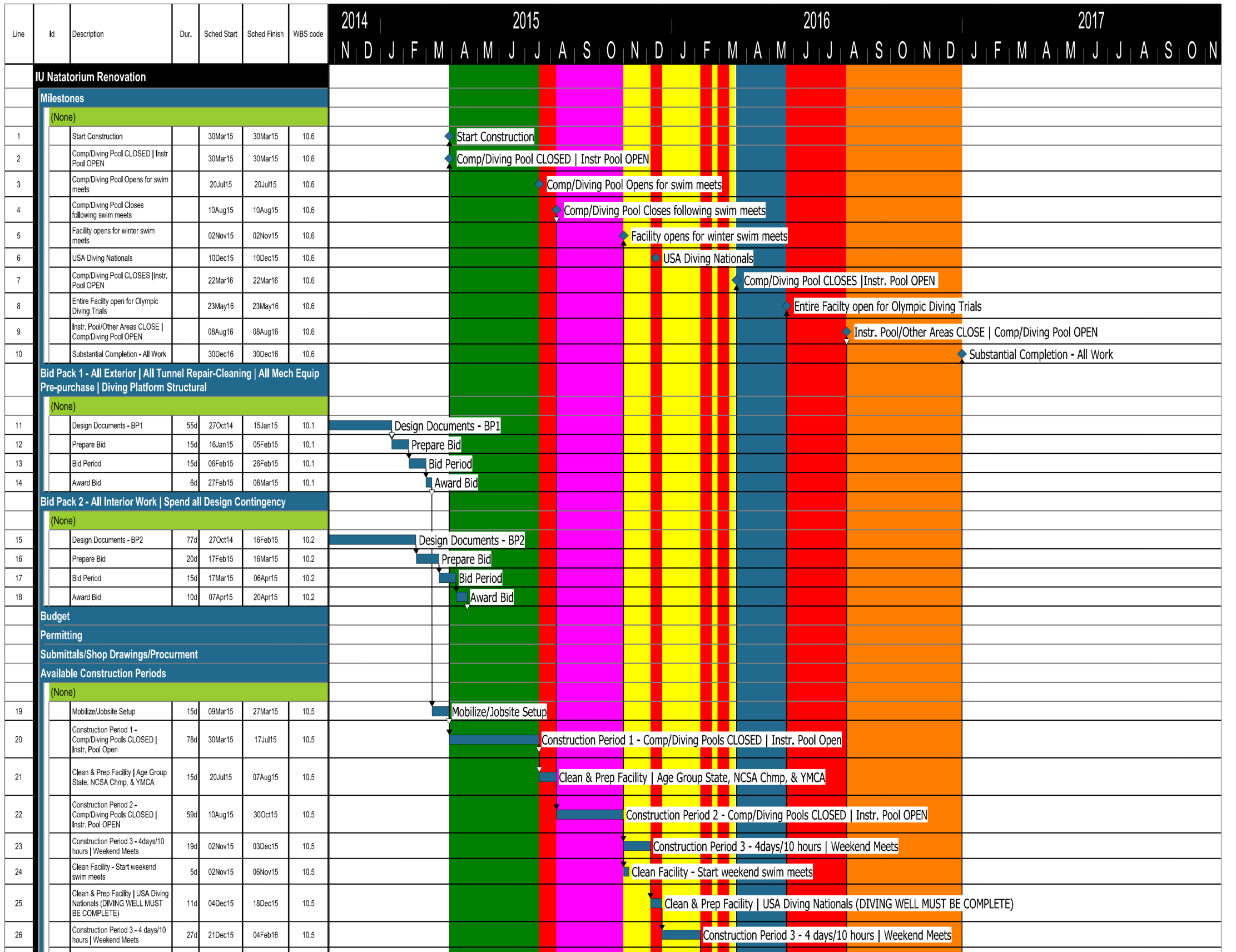
- Construction must work around meets
- Must be ready for the 2016 Olympic Dive Trials
- Must have locker rooms available to Indy 11 Soccer games
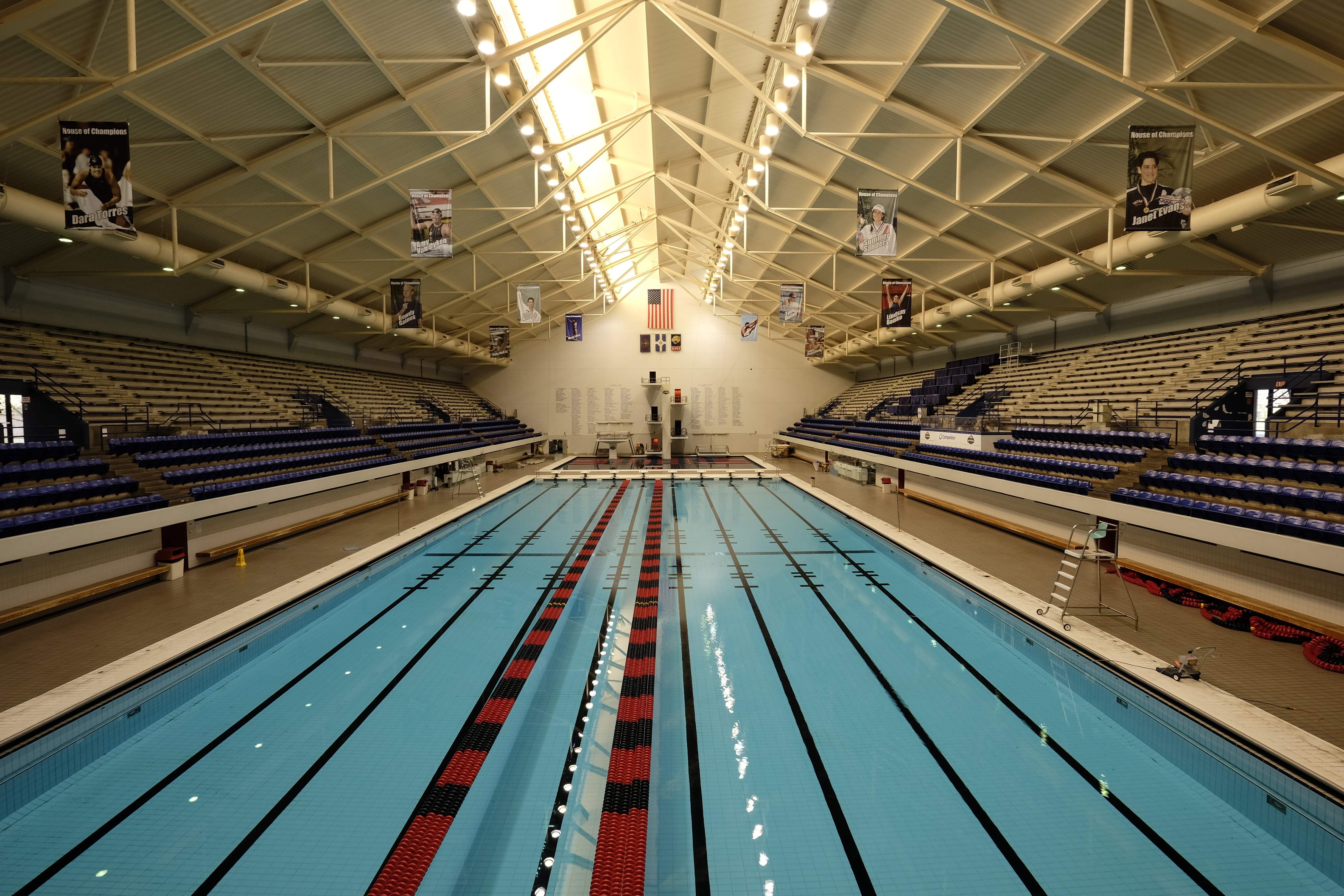
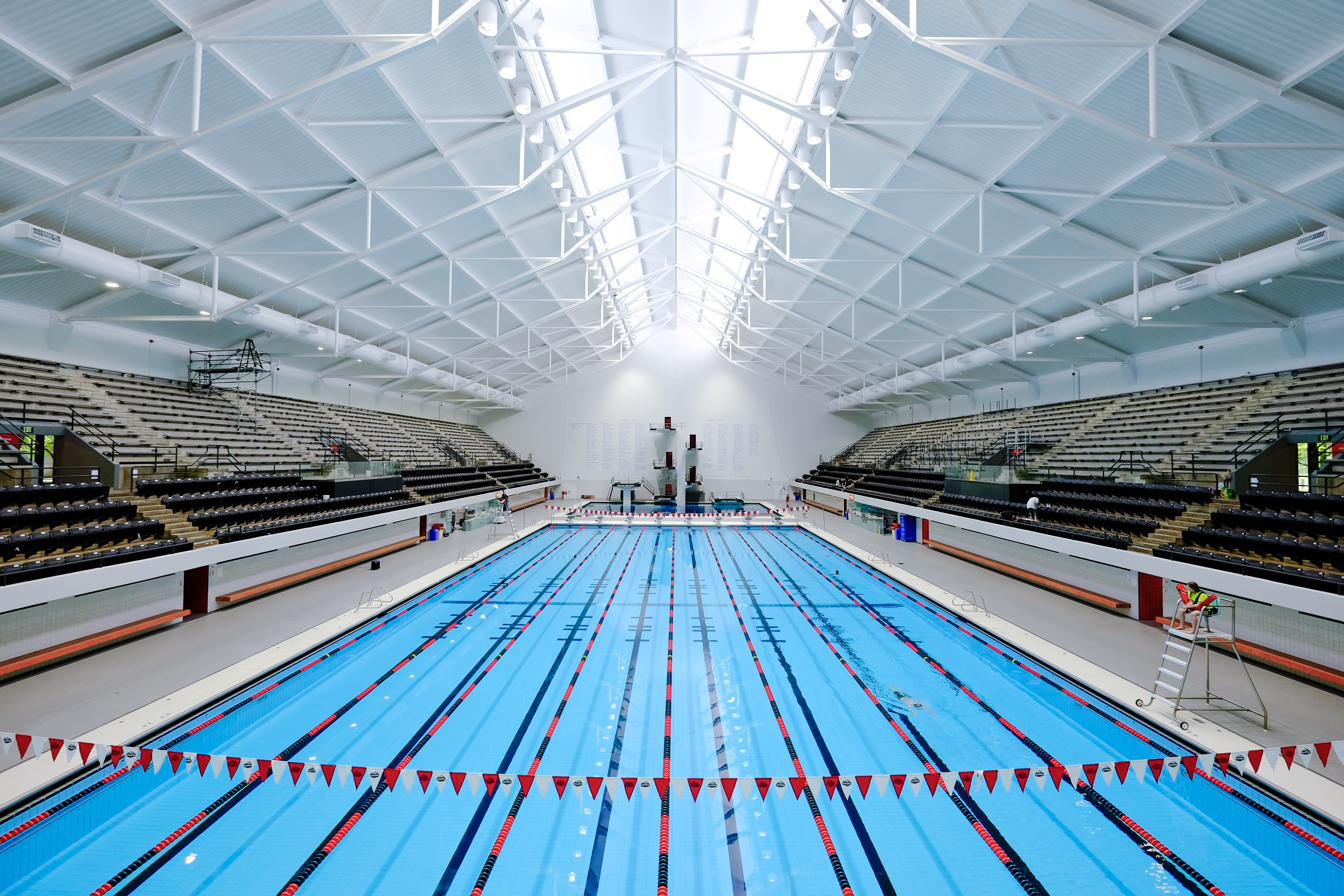
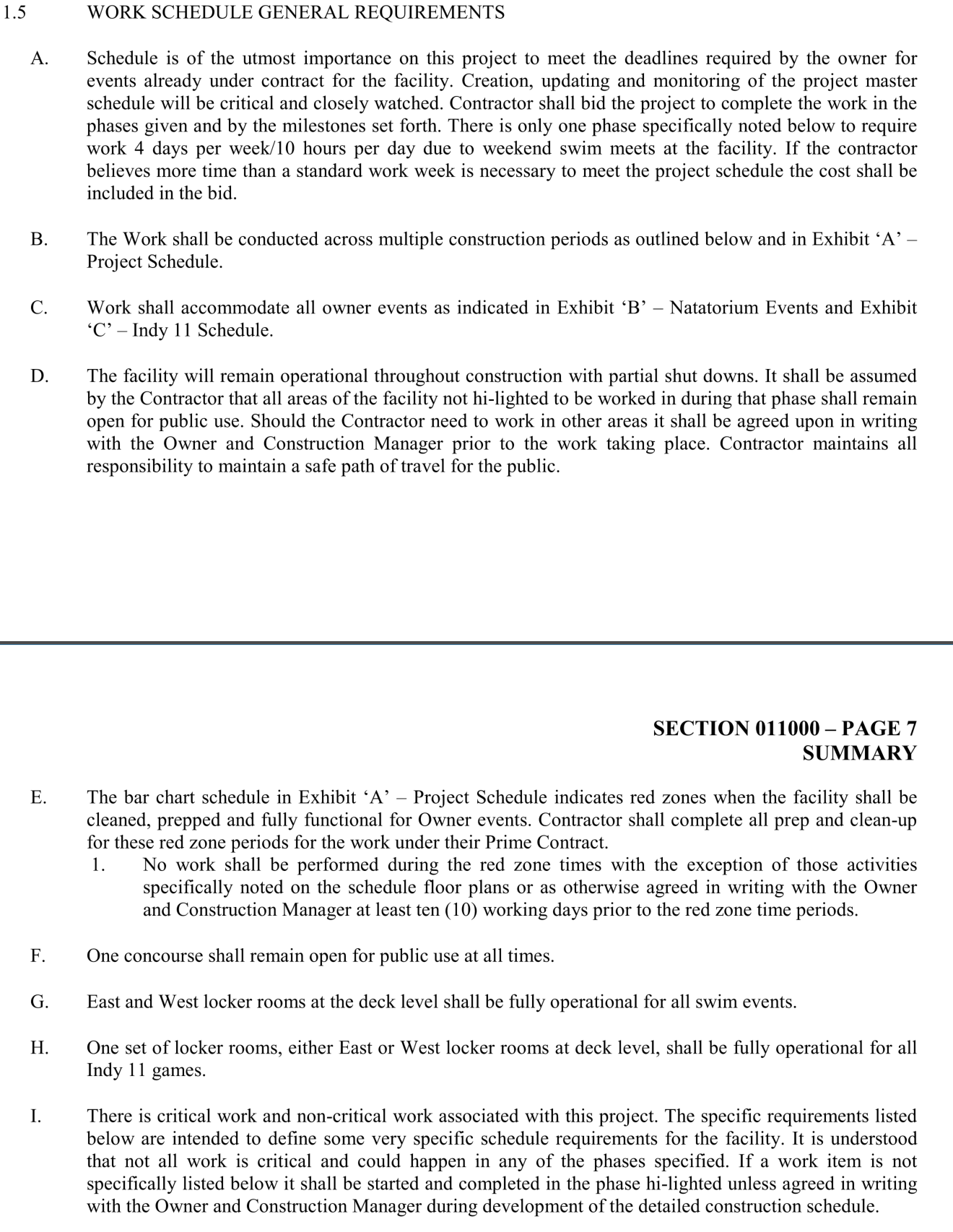
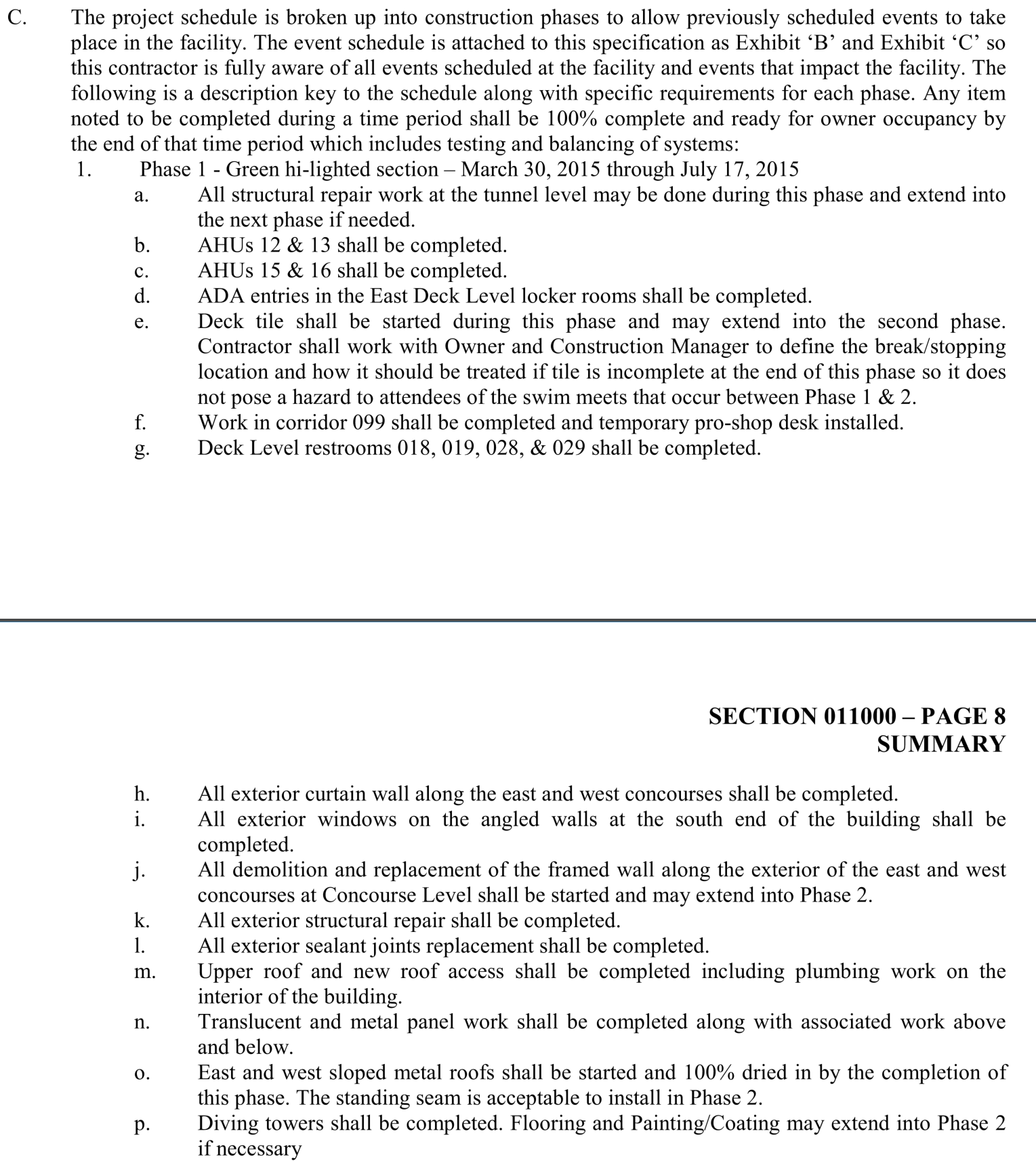
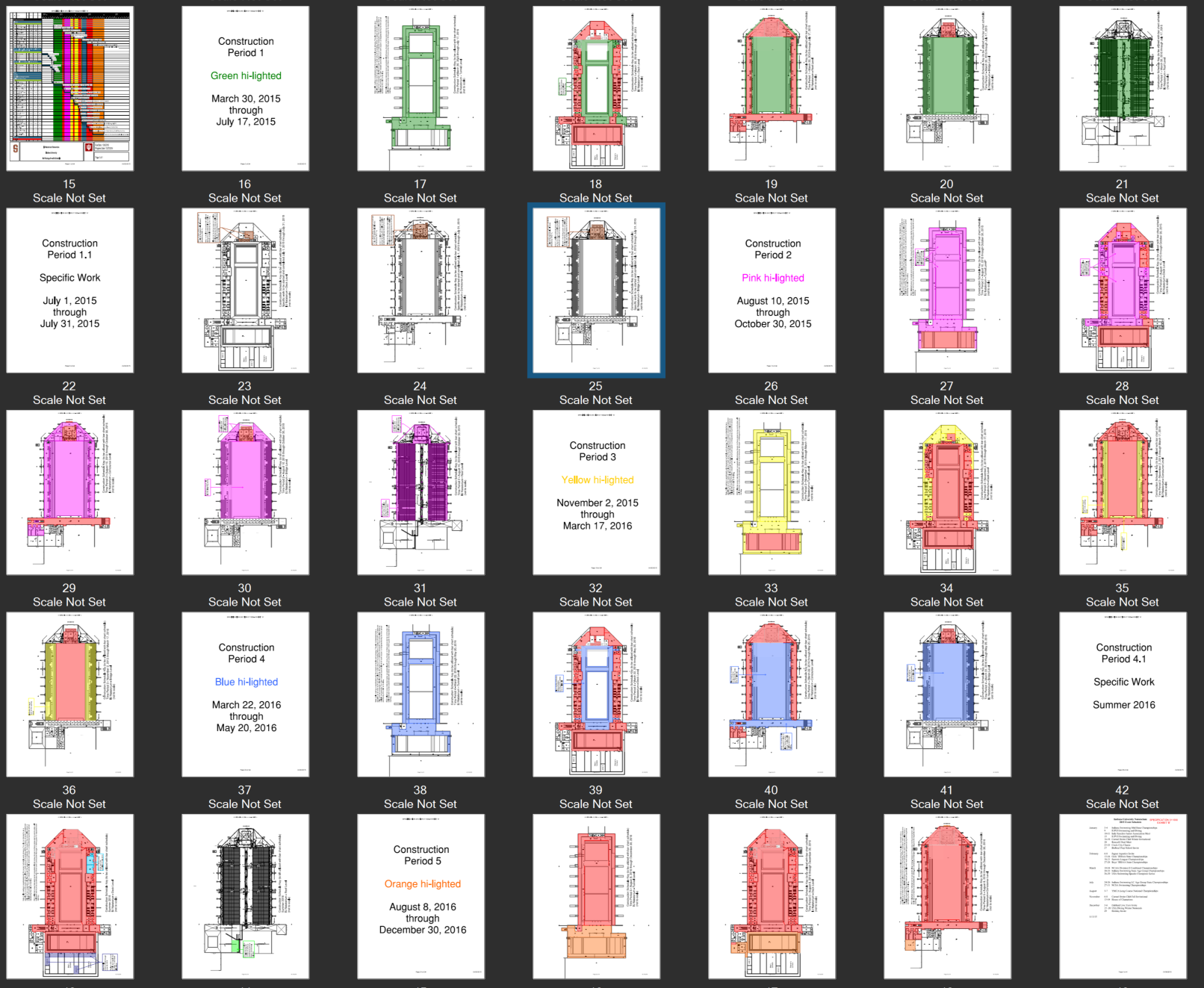
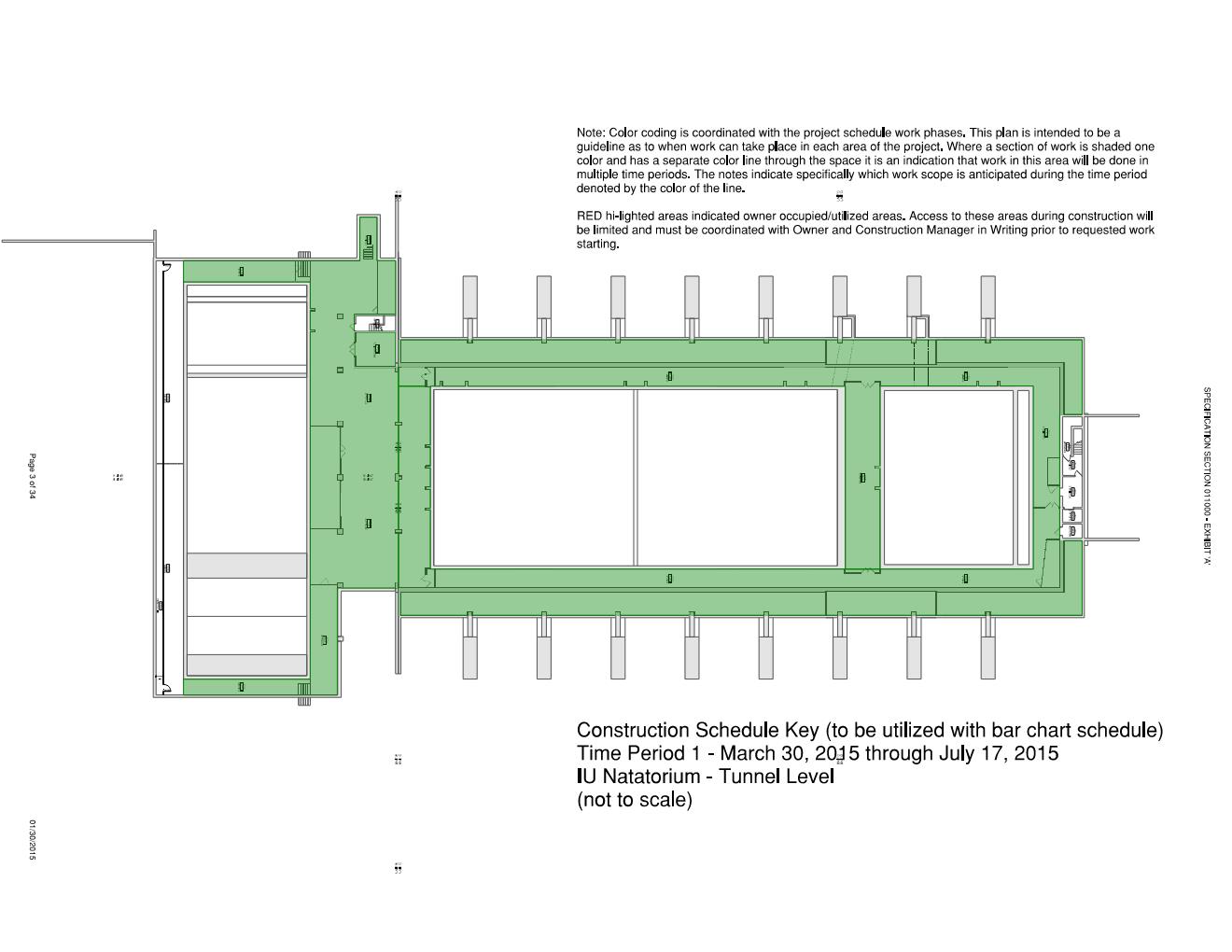
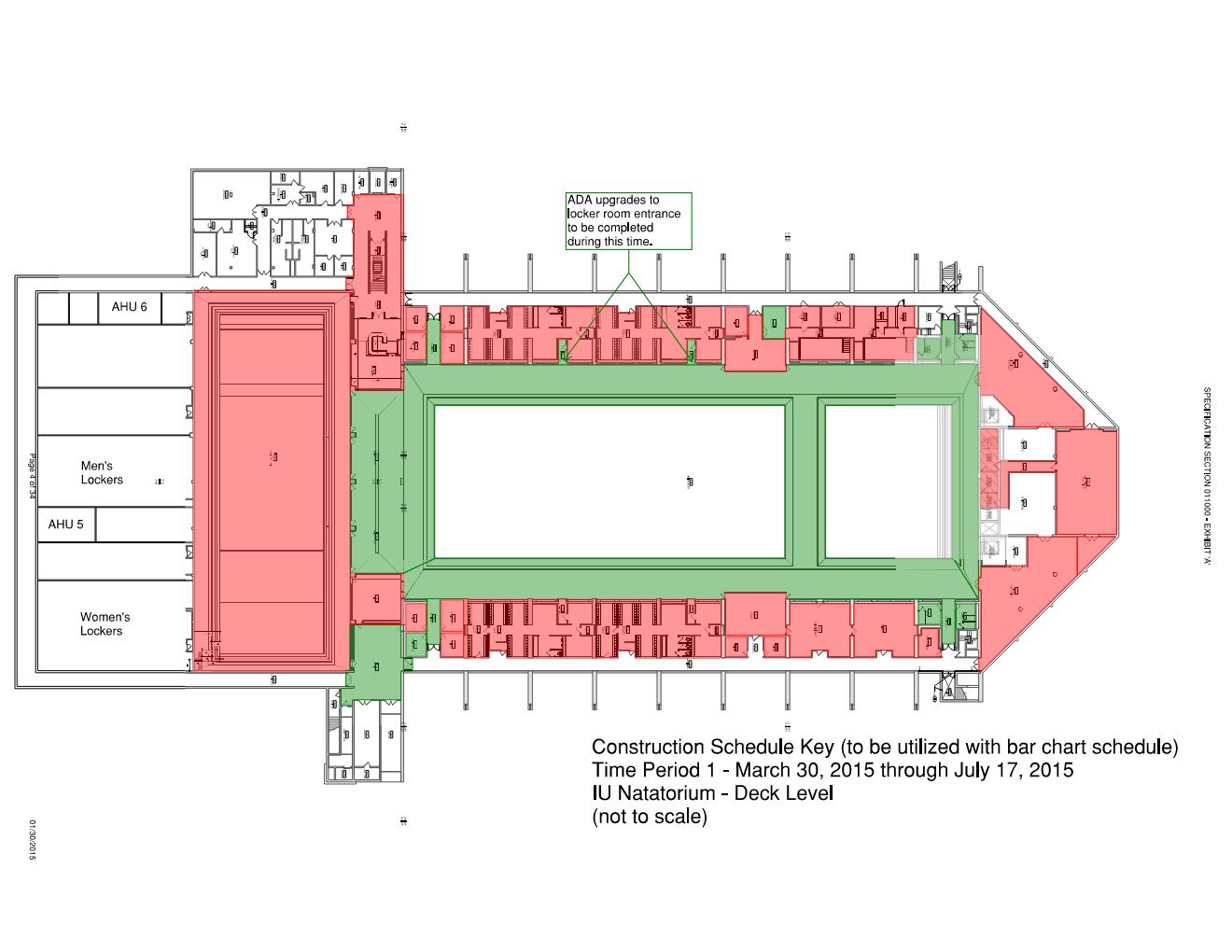
This was not a simple renovation to for minor cosmetic items. We had to replace mechanical systems, remove and replace the pool deck, replace the pool equipment system, drain/clean/refill the pools, structural repairs below deck, replace roof, replace clerestory translucent panels, replace lighting, replace seating, clean and paint ceiling, clean and paint dive well, refurbish locker rooms/offices/administrative spaces, main concourse, replace aluminum storefronts …you get the idea. Significant work and public bid. It is critical to provide a clear message to the bidders on how the schedule would be accomplished and share the critical dates for the facility. I created a color coded floor plan and schedule to show what work needed to be done in specific windows of time as well as which areas were off limits. I also did a complete write-up explaining the schedule as shown after the photos.
Planning this project was difficult and required a lot of creativity in breaking the scope into time frames it could reasonably be completed between swim meets. It took several months to come to our final schedule which was done while design was in progress.
There were challenges and a few nail-biting moments, but this schedule worked and everyone knew where they needed to be working and when. They also knew they needed to include multiple cleanings of the facility to be ready for critical meets. The project was completed on time.
PHYSICAL
Exactly what it sounds like. You need understand the physical site and everything around it. Take a lot of photos for reference later. Don’t start a project without documenting via photo and video the physical existing conditions all around your site. Google Maps satellite images are not always up to date with current conditions so you should not rely on it and take your own drone photos.
These items will impact your construction plan and the cost of work.
As-builts can be a good reference, but do not rely on them to accurately portray existing physical conditions until you have seen it for yourself. I have worked on many renovation projects where you walk the existing site or building and see pipes or structure in person that are not shown on old prints.
What type of physical constraints exist on the project that you may need to plan around or protect during construction?
- Streets
- Other buildings
- Other spaces within a renovation
- Existing sidewalks or paths that cannot be removed
- Trees
- Air space
- Transformers
- Phone boxes
- Etc.
What are you going to destroy that you need to repair at the end of construction?
- Existing streets
- Nearby landscape/grass areas
- Any existing items to remain that may be damaged
- Etc.
What is nearby that you need to be aware?
- Sleep center
- Critical care facility
- Neontal intensive care
- Other existing buildings
- Critical utilities
- Other construction activities
What is underground?
- Old building foundations
- Active underground utilities
- Tanks or other underground storage
- Water table
- Rock layers
All of these items may impact your plan and will definitely impact your budget. The following is an example project with the most notable physical constraints noted here.
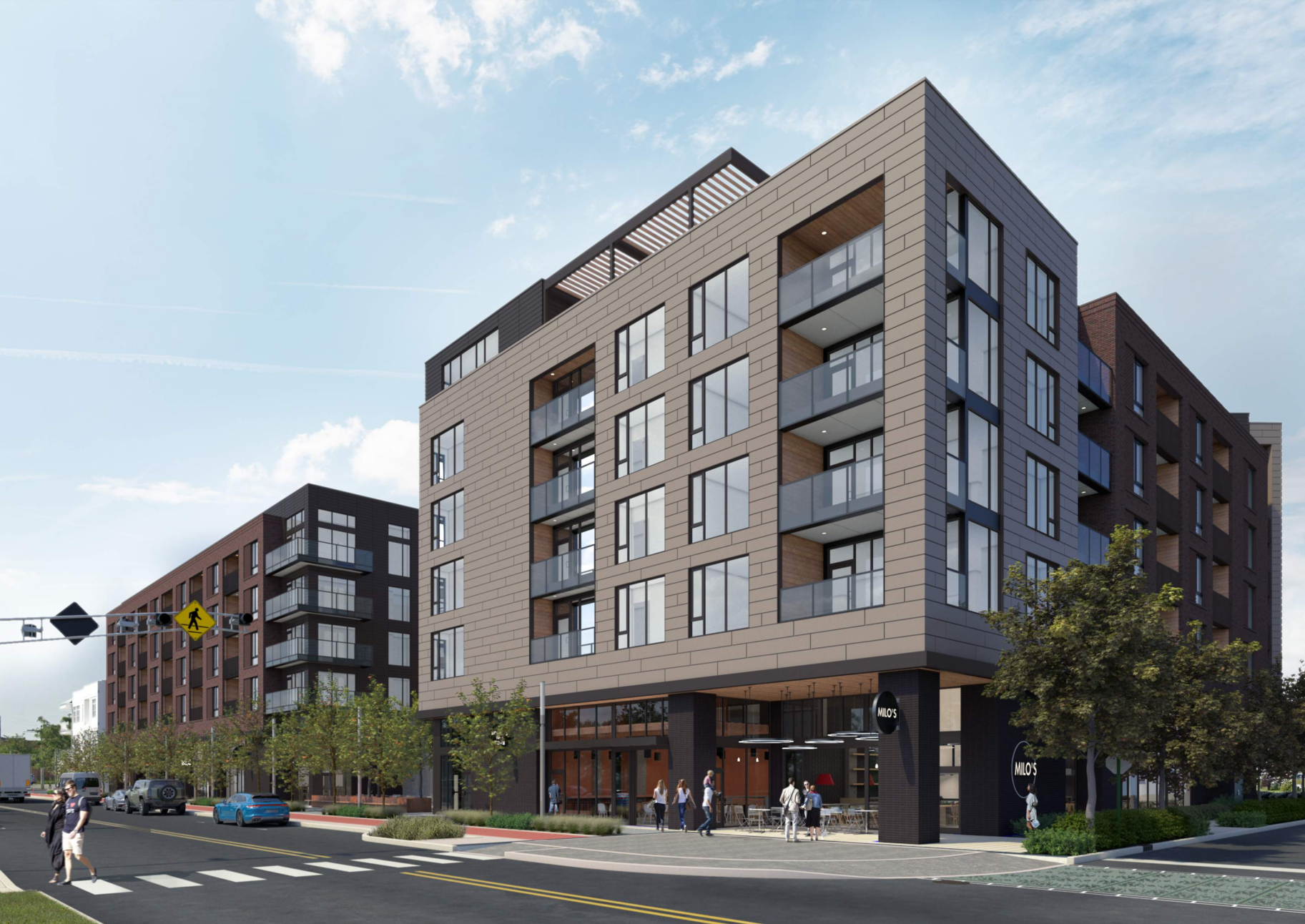
EXAMPLE PROJECT | POTENTIAL MULTI-FAMILY PROJECT
- Private project
- Multi-story wood frame building on top of a concrete podium with a basement
- Significant physical constraints and mitigation strategies below.
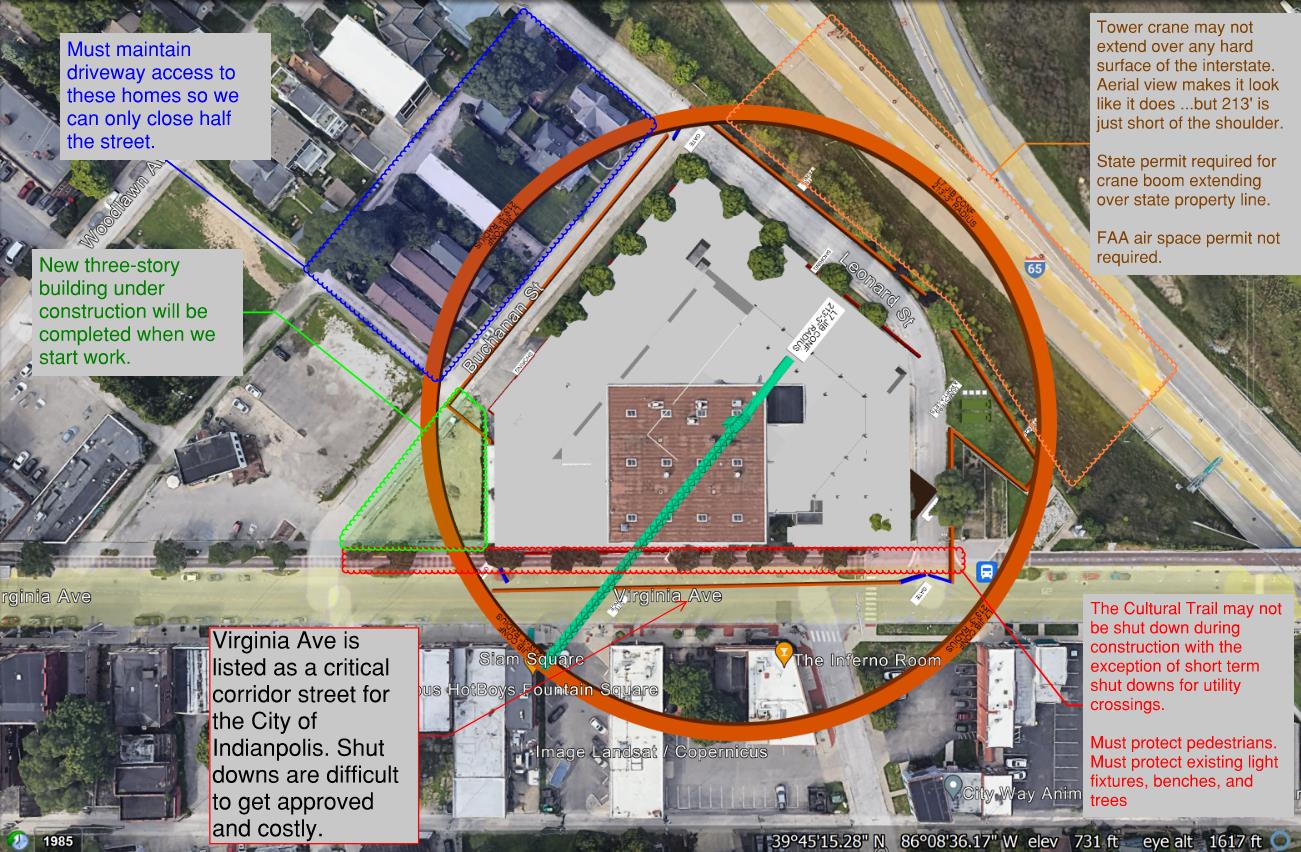
- Maintain Driveway access to residents
- We can only close half of Buchanan Street and change to one-way towards Leonard St.
- Utilize barricades with fence at this location to protect workers.
- City allows for a partial shutdown
- Cost of street closure and MOT (Maintenance of Traffic) included in budget
- Tower crane location and jib length
- We reviewed multiple options for cranes and settled on a tower crane.
- Jib extends over state property in the ROW for Interstate 65.
- Talked to State and they will allow this but jib must never extend over any hard surface
- Permit required prior to crane erection
- 213′ boom/jib just fits within these requirements
- Allows for best access to offload trucks from Leonard St.
- Limited number of tower cranes available so it is good to have this plan and reserve a crane early.
- Cultural Trail location adjacent to building
- Cannot shut down the cultural trail
- Met with Indianapolis Cultural Trail to review options
- Must keep it open. Exception is short shut downs for utility crossings
- Must provide signage and protected alternate path around closing
- Must replace and repair sections against the new building
- Must do delicate demo and save existing pavers to be set back in place after construction
- Provided as-builts to allow coordination with extensive underdrain system
- Must protect trees – cannot remove and replace
- Must protect people on the trail
- Significantly increases the difficulty of building this facade
- We opted to proceed with a shared scaffold system we will provide and control
- The scaffold will extend over top of the cultural trail to protect it.
- We will remove existing expensive light fixtures and provide temporary lighting under scaffold
- Lights to be reset at completion of construction
- Scaffold will be built around trees to protect them.
- We opted to proceed with a shared scaffold system we will provide and control
- Parking lane will be closed to cars and utilized for lifting materials to the scaffold
- Cost of closure and MOT included in budget
- We included the delicate removal of the existing pavers, stacking on pallets, and storage off site to assure no damage during construction.
- Shoring included in this area for basement construction due to insufficient room to slope 1.5:1.
- Cannot shut down the cultural trail
- Virginia Ave is a critical corridor
- We are fortunate that utility tie-ins are limited in this area.
- Shut down of critical corridors is expensive and difficult
- We will have to work in one lane of traffic at a time and bid scopes include this work with the site utilities company
- New construction of three story building
- Will be demolishing an existing building within 15′ of the new building.
- No as-builts available
- Concerned about depth of existing foundations and undermining new construction
- Allowance included for underpinning and investigation prior to work.
- Impacts construction of this facade and limits the type of scaffold that can be utilized.
- We opted to include this with our shared scaffold to be coordinated with successful bidder for best access system.
- Will take photos, install vibration monitoring and protect building during construction.
- Will be demolishing an existing building within 15′ of the new building.
- Other items not shown on the map
- Existing storm drains on Leonard St clogged. Street floods when it rains
- Included in civil design to clear blockage
- We will connect to existing storm drains so we brough a surveyor on site to check elevations for the civil engineer
- Existing power lines to site do not match plan
- Met on site with power company to review plans for removal of existing lines and how to connect construction trailers
- Noticed existing conditions around the site are very poor
- Included allowance to replace asphalt on Leonard St. (It is a mess of potholes!)
- Included allowance to restripe cultural trail crossing at Leonard St as construction traffic will destroy this location
- Identified UPS drop box on property for the Owner to call and have removed
- Existing storm drains on Leonard St clogged. Street floods when it rains
You can see how quickly these physical constraints impact the construction plan and budget. Without the initial investigation and curiosity about the site we could quickly consume contingency and impact the construction schedule of the project.
SUMMARY
Be curious about constraints and mitigate them as a part of your construction plan. The more you know before construction starts the smoother your project will run.
I hope this is helpful. Let me know in comments. The greatest compliment is to share my work with others.

 douglas adams